
Did AI prove the Riemann Hypothesis?
Contents
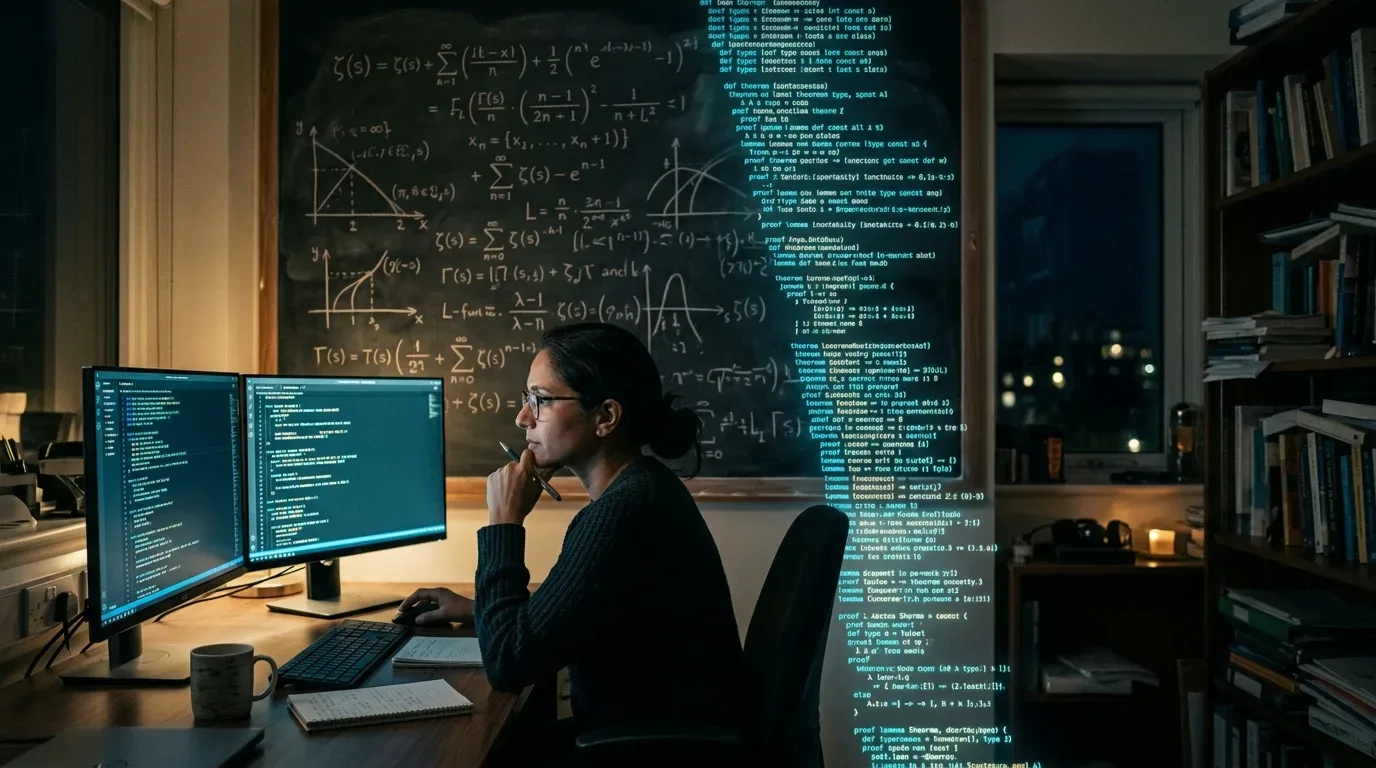
Theoretical computer scientist Scott Aaronson recently reviewed a claim in analytic number theory: researcher Levent Alpöge reported prompting Anthropic models to prove the Generalized Riemann Hypothesis (GRH), generating 17.4 million lines of formal Lean code.
17.4 million lines of Lean code
The submission does not use standard academic prose. It relies entirely on Lean, an interactive theorem prover based on dependent type theory. A human reviewer cannot read 17 million lines of logic, but the formal proof checker can verify the consistency of each deduction mechanically.
Aaronson points out that the sheer size makes understanding the underlying ideas difficult. The verification work shifts away from peer-review reading toward checking the soundness of the Lean kernel itself.
The stake in the Riemann Hypothesis
Bernhard Riemann formulated the problem in 1859, proposing that all non-trivial zeros of the zeta function sit on the critical line with real part 1/2. The location of these zeros determines the error term when estimating how prime numbers are distributed.
David Hilbert once said that if he awoke after five hundred years, his first question would be whether the Riemann Hypothesis had been solved.
Earlier automated work showed that non-trivial zeros lie within 3/8 of the line. If Alpöge's full formal proof holds up, it will settle open bounds across number theory and cryptographic assumptions that rely on them.
Kernel soundness and P vs NP
Formal systems can have bugs. Lean has had historical issues where rare edge cases permitted unsound steps. Aaronson notes that while certified AI outputs have held up well so far, reviewers must audit the verification environment before accepting the result. If this automated workflow proves reliable, researchers will likely point the same tools at problems like P vs NP.
Related posts

Language Models Can Rewrite Their Own Weights
Researchers show that language models can inspect and update their own parameter weights via reasoning, skipping traditional backpropagation.

How Anthropic Validates Claude's Code
Anthropic explains how Claude writes and reviews 90% of its codebase, limits inference costs, and prevents automated tests from being manipulated.
Apple Is Developing an AI Agent to Control Your Mac
Apple is building an autonomous AI agent capable of operating macOS, running commands, and coding, while tightening third-party agent system access.