

FCC Approves SpaceX AI Data Centers in Space
Contents
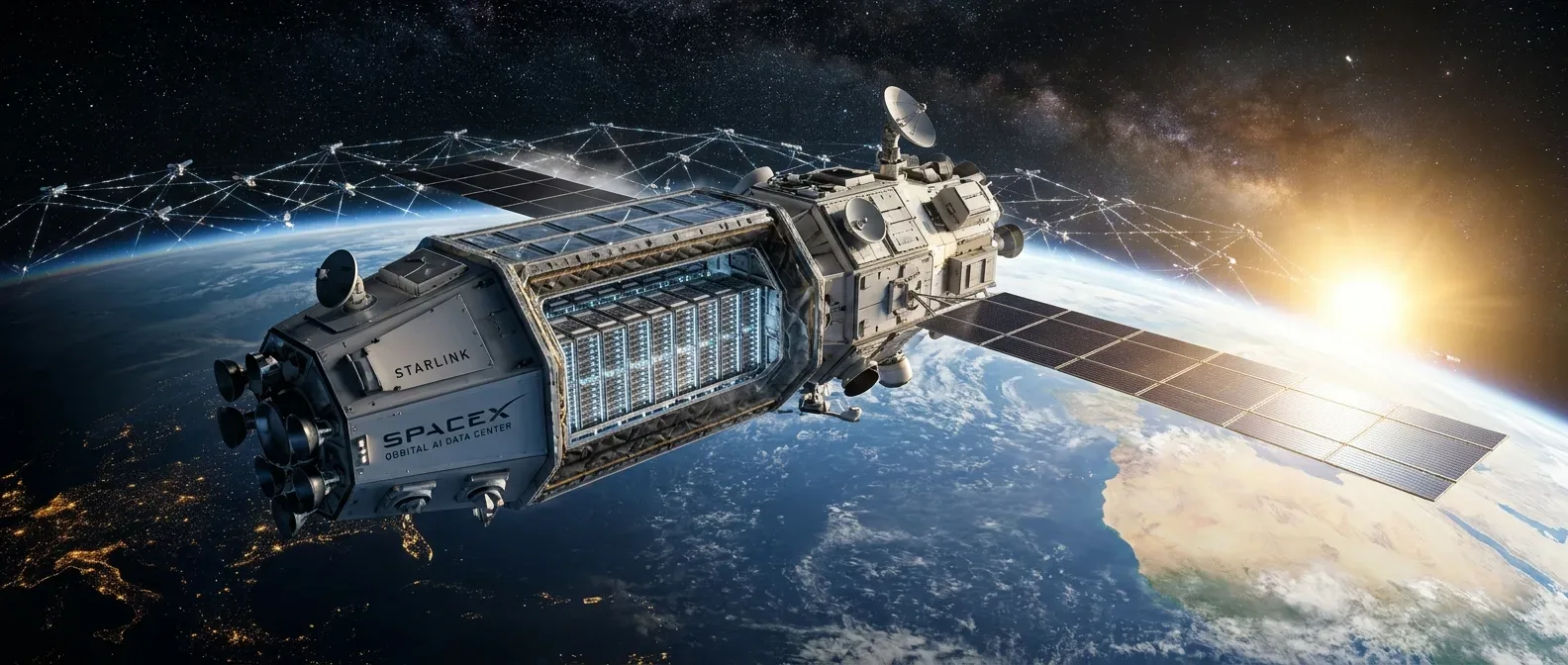
The Federal Communications Commission (FCC) granted conditional approval to SpaceX to deploy up to 1 million satellites for orbital AI processing. Operating under the project name Starmind, the constellation aims to move high-density compute tasks from terrestrial power grids into low Earth orbit.
Industry objections and regulatory scope
The authorization arrived despite objections from Amazon, Viasat, and the American Astronomical Society (AAS). Critics warned of orbital congestion, higher collision risks, and radio interference with deep-space observations. Amazon argued that the filing lacked a realistic engineering plan. The FCC dismissed the astronomical objections, stating that observational impacts fall outside its statutory authority.
FCC Chair Brendan Carr said the decision supports domestic computing infrastructure, while Elon Musk posted that the approval marks a major step for the company's orbital plans.
Starmind constellation architecture
SpaceX plans to place the Starmind satellites at altitudes between 500 and 1,002 kilometers. The network relies on optical inter-satellite links (ISLs) to pass data between nodes and the existing Starlink fleet. Secondary radiofrequency bands will handle telemetry, tracking, and control if optical links fail.
constellation_spec:
  project_name: "Starmind"
  satellite_count_max: 1000000
  target_altitude: "500km - 1002km"
  inter_satellite_link: "Optical Laser (ISL)"
  backup_control: "RF Telemetry"
  deployment_deadlines:
    first_launch: "7 years"
    full_constellation: "14 years"
Technical hurdles: Vacuum heat dissipation and debris waivers
Even with regulatory clearance, running AI hardware in orbit leaves several unresolved engineering problems:
- Thermal Radiative Cooling: Because space lacks air for conduction or convection, heat generated by accelerator chips can escape only through radiation panels. That requires large surface areas and adds significant mass.
- Component Radiation Hardening: Standard AI processors and GPUs fail more often under cosmic rays. Using them reliably in orbit requires radiation-hardened silicon or redundant circuitry.
- Orbital Debris Rules: The FCC has not approved SpaceX's debris plan for satellites above 600 kilometers. Standard rules require operators to deorbit retired craft within five years. SpaceX is seeking a waiver to move decommissioned units into graveyard orbits or toward the Sun instead.
Under the FCC timeline, SpaceX has seven years to launch its first operational satellite and 14 years to complete the constellation.
Related posts
Jensen Huang Breaks Nvidia Code of Conduct
Nvidia CEO Jensen Huang acknowledged violating company conduct rules during an all-hands meeting, raising concerns about workplace fairness.

Lean Verification of the Riemann Hypothesis
Levent Alpöge's formal proof of the Riemann Hypothesis has been certified using Lean and Mathlib.