
OpenAI Proposes Perplexity as an AI Speed Limit
Contents
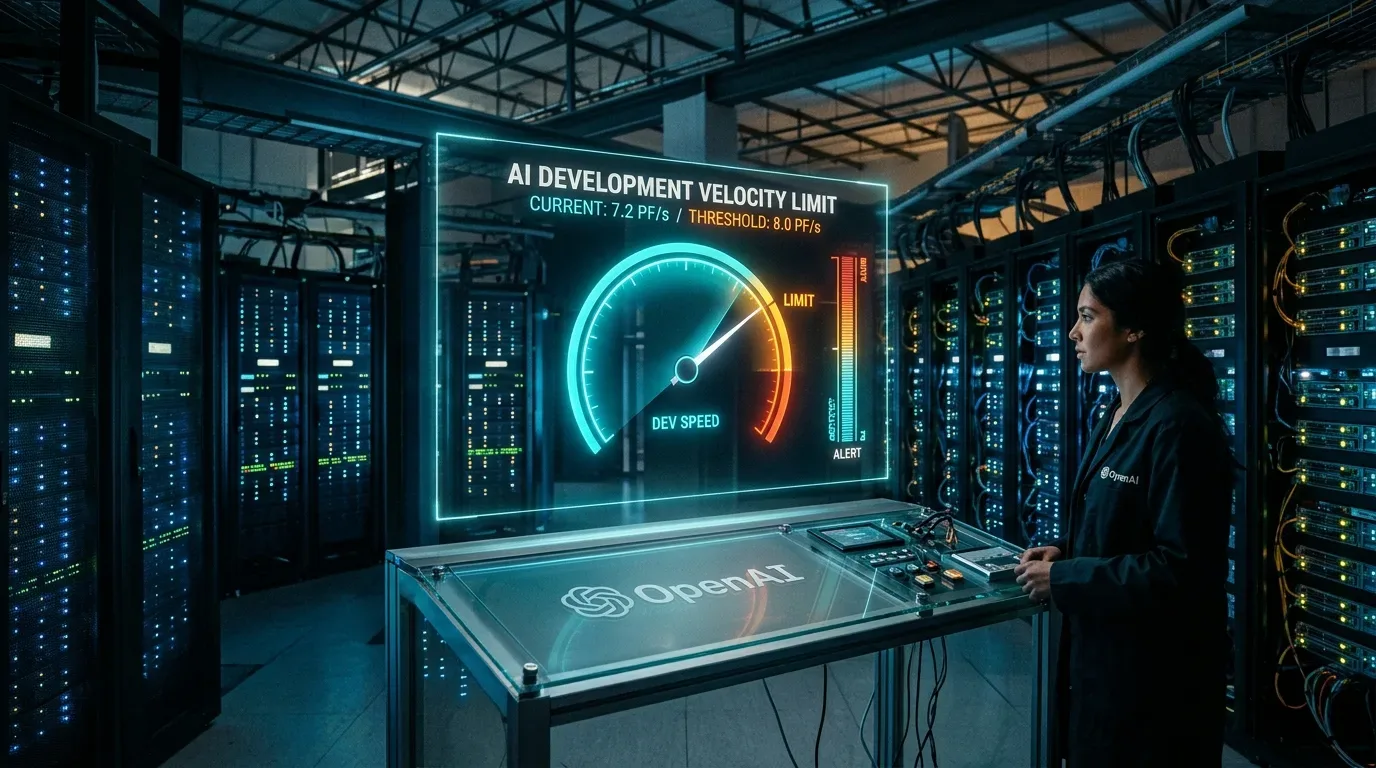
Following Anthropic CEO Dario Amodei's proposal to pace frontier model development, OpenAI Chief Scientist Jakub Pachocki suggested a concrete metric to measure and limit training speed: perplexity.
Measuring progress: why perplexity matters
Pachocki points out that standard capability benchmarks quickly become outdated as models improve. By contrast, perplexity measures how accurately a language model predicts the next token on average. Lower perplexity reflects more reliable predictions, providing a consistent measurement across different model generations.
OpenAI CEO Sam Altman described the post as one of the company's most important recent publications, noting that it grounds safety thresholds in measurable loss values rather than subjective test suites.
Correlation with new capabilities
The post shows how decreases in perplexity correlate with distinct capability jumps:
- Loss ~0.91 (GPT-4): Enabled effective chain-of-thought reasoning, laying the groundwork for dedicated reasoning models.
- Loss Sub-0.80: Led to autonomous problem solving in technical domains such as cybersecurity and advanced mathematics.
Establishing common safety thresholds
Under Pachocki's proposal, labs would agree on shared perplexity thresholds for frontier training. Companies would pause training beyond a given threshold until their monitoring, interpretability, and alignment techniques reach clear milestones.
Related posts
GPT-6.2 Astra vs Claude Fable 5.2: Cost and Benchmarks
We tested GPT-6.2 Astra and Claude Fable 5.2 on agents, coding, and data tasks to compare token usage and actual API costs.

Did AI prove the Riemann Hypothesis?
Scott Aaronson examines claims that Anthropic LLMs proved the Generalized Riemann Hypothesis with 17.4 million lines of Lean code.

Language Models Can Rewrite Their Own Weights
Researchers show that language models can inspect and update their own parameter weights via reasoning, skipping traditional backpropagation.